Extension

WordPress plugin: see what nobody sees from outside

The DomainWarn plugin adds the addresses of your WordPress site to monitoring and reports every 15 minutes what no outside check can see: versions, pending updates, the mail setup – and whether WP-Cron still runs.

Free. What is charged is the monitoring service, not the extension.

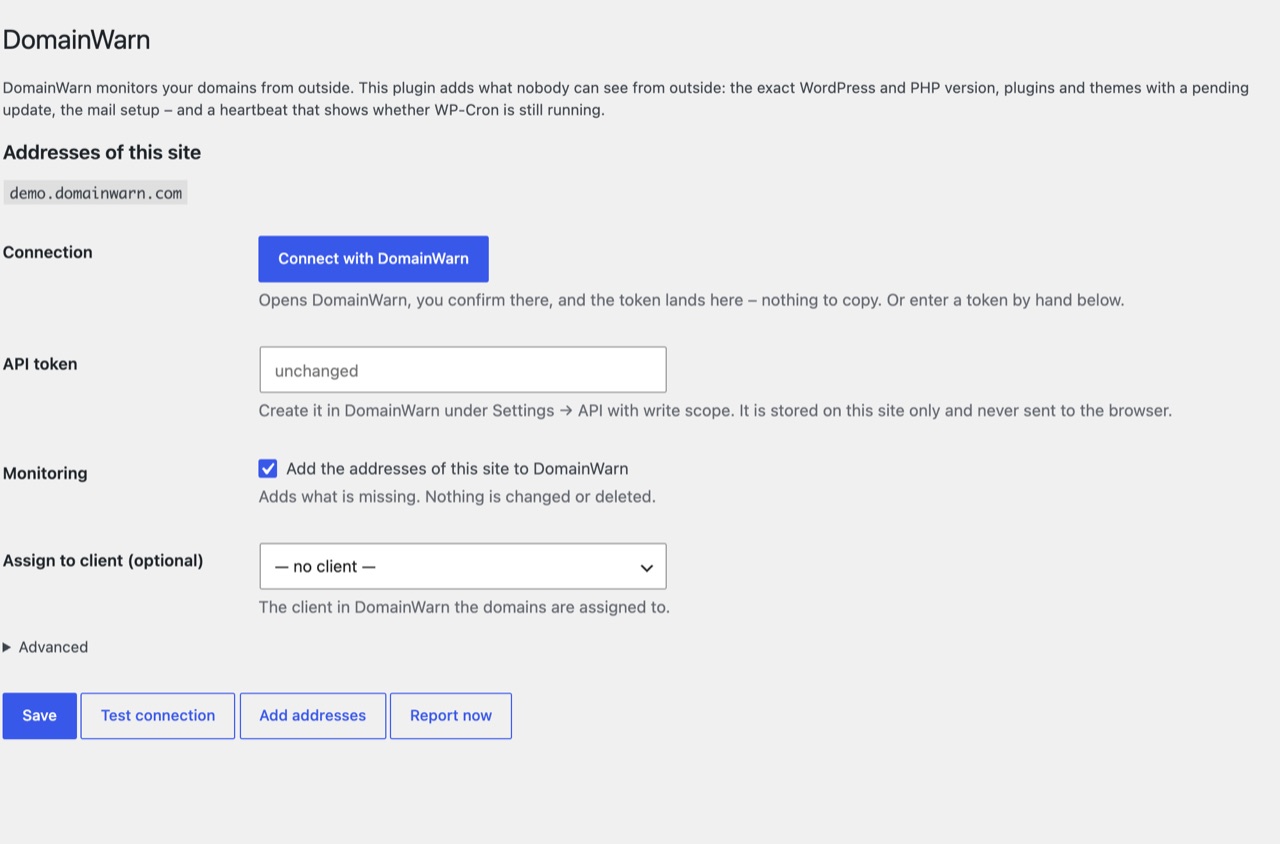
Settings → DomainWarn in WordPress: the addresses of the site, the connect button, the API token field and the client selection.

For agencies with many WordPress sites

If you look after dozens of client sites, you do not log in to every install each week. With the plugin, WordPress and PHP version and the pending updates of every site sit in the same dashboard as certificate, DNS and email – sorted by client, with alerts to your channels.

The plugin adds the addresses of the site by itself, every site in a multisite network, and assigns them to the right client if you like. It only adds what is missing; nothing is changed or deleted.

What the plugin reports

  • WordPress and PHP version

    The exact version instead of a guess. Whether it is outdated or no longer gets security updates is judged by DomainWarn from the current releases and the PHP support periods.

  • Pending updates

    Plugins and themes with an available update, each with the installed and the available version.

  • Mail setup

    Sender address and mail server. Together with the DNS records this yields the finding "your site sends through a server that is not in the SPF record" – which neither the site nor an outside check can reach on its own.

  • Maintenance mode

    If maintenance mode stays on by accident after an update, the site is closed to visitors and search engines. DomainWarn points it out.

  • WP-Cron heartbeat

    A scheduled run reports in every 15 minutes. If it stops, WP-Cron has stalled: the site still answers, but no mail goes out and nothing is processed. DomainWarn then opens an incident and sends it to your channels.

Set up in three steps

  1. In the WordPress admin go to Plugins → Add New, search for "DomainWarn", install and activate it.
  2. Under Settings → DomainWarn click "Connect with DomainWarn". You confirm in DomainWarn, and the token lands on the site by itself – nothing to copy. A free account is enough.
  3. "Add addresses" – done. Pick a client if you like; from then on the plugin reports every 15 minutes.

Prefer to do it by hand? Create a token with write scope in DomainWarn under Settings → API and paste it into the "API token" field. On the command line the same steps are wp domainwarn test, wp domainwarn sync and wp domainwarn report.

For the heartbeat to work, WP-Cron must run – which is exactly what it checks.

Requirements

WordPress 6.3 or newer, PHP 8.2 or newer and a DomainWarn account – the free one is enough.

Which data is transmitted

Transmitted are the addresses of the site, WordPress and PHP version, names and versions of installed plugins and themes, sender address and mail server, and the maintenance mode. Not transmitted are users, posts, comments, orders or any other content. The API token stays on the site and never reaches the browser; without a token the plugin stays idle and contacts nothing.

Setup, inside view and heartbeat for all extensions are described in detail in the documentation.Integrations in the docs

Frequently asked questions

Do I need a paid account?
No. The plugin is free and works with the free DomainWarn account. What is charged is the monitoring service, once more domains or shorter check intervals are needed.
Is content of my site transmitted?
No. Transmitted are addresses, versions, installed plugins and themes, sender address and mail server, and the maintenance mode. No users, posts, comments or orders.
Why does DomainWarn open an incident although my site is up?
Because the heartbeat stopped. Then WP-Cron has stalled: the site still answers, but it sends no mail and processes nothing.
Does the plugin work with a self-hosted DomainWarn?
Yes. The API address can be changed on the settings page under "Advanced".

Create an account, connect the extension

Signing up takes a minute. Then you connect the extension in one click, and the inside view sits next to certificate, DNS and email of the same domain.

Every feature, no credit card, cancel monthly.

More extensions: Shopware extension · Chrome extension · All integrations